Extraordinary Update – New SVHC Substance Added to Candidate List!
On November 5, 2025, the European Chemicals Agency (ECHA) made an unscheduled addition of another substance of very high concern (SVHC) to the REACH Candidate List – the list now comprises 251 entries!
Unlike the regular biannual updates (most recently in June 2025), this is an extraordinary publication, which underscores the urgency of this measure.
The New Substance at a Glance:
1,1′-(Ethane-1,2-diyl)bis[pentabromobenzene] (DBDPE)
- EC: 284-366-9
- CAS: 84852-53-9
- Classification: Very persistent and very bioaccumulative (vPvB)
What is Decabromodiphenylethane (DBDPE)?
DBDPE is a brominated flame retardant developed as a substitute for decabromodiphenyl ether (DecaBDE) – a substance that was already restricted under the RoHS Directive in 2008. Ironically, this substitute has now been found to pose significant environmental and health risks as well.
Where is DBDPE Used?
The substance is employed in various industrial applications:
- Formulation of flame retardants
- Manufacturing of thermoplastics and resins (masterbatch and compounds)
- Electronic components and housings
- Adhesives, sealants, and coatings
- Printing inks
- Textiles and upholstery materials
- Cables and wiring
Trade names: Ecoflame B-971, Firemaster 2100DR, SAYTEX
Why is DBDPE Problematic?
ECHA classifies the substance as very persistent and very bioaccumulative (vPvB). This means:
- It accumulates in the environment and barely degrades
- It accumulates in organisms and can bioaccumulate in the food chain
- Long-term environmental and health risks are significant
Which Industries are Affected?
Companies using DBDPE in their products or supply chains are subject to new obligations, including information requirements along the supply chain and potential authorization requirements in the future.
Particularly affected are:
- Electronics industry (PCBs, housings, components)
- Plastics processing (masterbatch manufacturers, compounds)
- Automotive suppliers (interior fittings, cables, electronics)
- Furniture and textile industry (upholstery materials, fabrics)
- Construction industry (insulation materials, cables, coatings)
- Distributors of chemicals and raw materials
Your Obligations:
With the inclusion in the SVHC Candidate List, the following applies immediately:
- Information obligation according to Article 33: If articles contain more than 0.1% by weight of DBDPE, recipients and consumers must be informed
- Notification obligation to ECHA: For more than one tonne of DBDPE per year in articles
- Supply chain communication: Customer inquiries must be answered within 45 days
Activate the New REACH Regulation in Three Clicks!
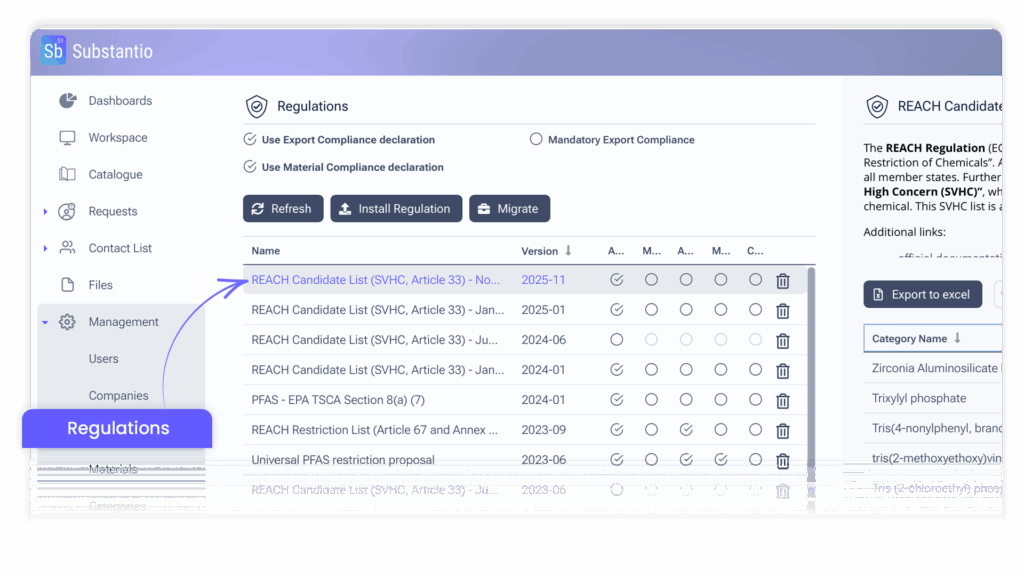
The Substantio software will shortly be updated to the current Candidate List, allowing you to check your bills of materials for the new SVHC substance – activated with one click.
Here’s How:
- Open your Substantio software and click on “Administration” > “Regulations” in the left menu bar.
- Here you will see the list of installed regulations and their updates.
- Search for “REACH Candidate List (SVHC, Article 33) – November 2025” and check the box for “Active”.
Ensure Compliance Now:
✅ Automatically check your entire bill of materials for DBDPE
✅ Identify affected materials and components
✅ Launch automated declaration requests to your suppliers
✅ Document your REACH compliance comprehensively
Why This Extraordinary Update Matters
The fact that ECHA added this substance outside the regular six-month cycle underscores its urgency. As one of the most commonly used substitutes for DecaBDE, DBDPE affects a wide range of products and supply chains.
Act now to minimize compliance risks and avoid legal consequences!
If you have any questions about implementation or the Substantio software, please don't hesitate to contact us!
Further Links:
- ECHA Announcement
- REACH Regulation (EC) No 1907/2006
- LUBW Landesanstalt für Umwelt Baden-Württemberg: Reach